

OSTASIA TRADING PTE. LTD partnership for the Asian Market
01/05/2012
Introducing ICO-PRINT
03/10/2016
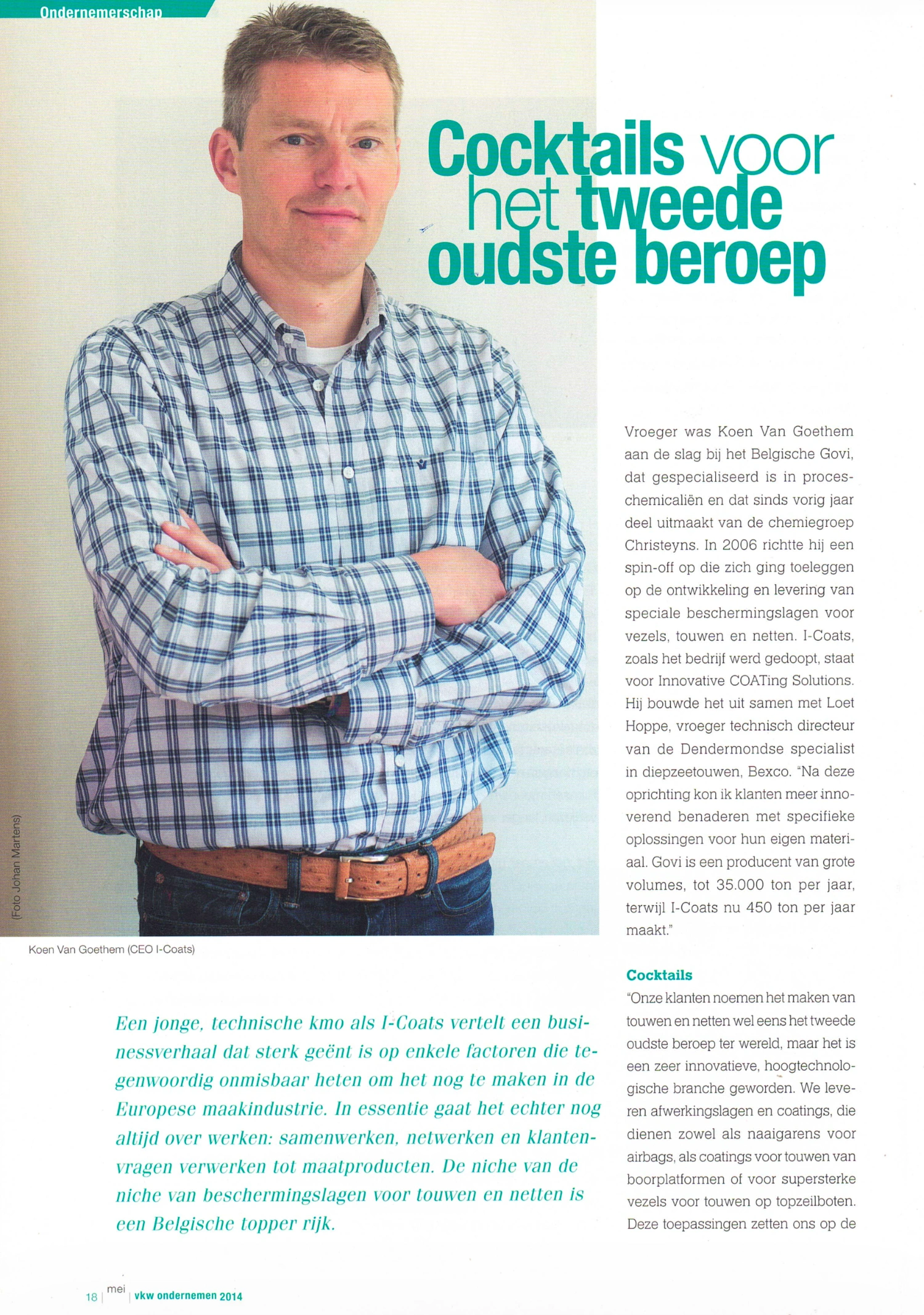
Cocktails for the World's Second-Oldest Profession
Entrepreneurship - VKW Ondernemen -May 2014
Koen Van Goethem previously worked at the Belgian firm Govi, a specialist in process chemicals that became part of the Christeyns chemical group last year (2013). In 2006 he founded a spin-off dedicated to developing and supplying specialty protective coatings for fibres, ropes and nets.
The company, christened I-Coats, for Innovative COATing Solutions, was built together with Loet Hoppe, formerly technical director at Bexco, the Dendermonde-based specialist in deep-sea ropes.
"Setting up this company allowed me to approach customers in a far more innovative way, with solutions tailored to their own materials," Van Goethem says. "Govi is a high-volume producer, making up to 35,000 tonnes a year, whereas I-Coats currently produces 450 tonnes a year."
A young, technical SME, I-Coats tells a business story firmly rooted in the factors now considered essential to surviving in European manufacturing. At its core, though, it still comes down to work: collaborating, networking and turning customer questions into bespoke products. And in the niche-within-a-niche of protective coatings for ropes and nets, this Belgian company is a world leader.
Cocktails
"Our customers sometimes call rope- and net-making the world's second-oldest profession," Van Goethem says, "but it has become a highly innovative, high-tech industry. We supply finishing layers and coatings that serve as sewing threads for airbags, as coatings for the ropes used on drilling platforms, and as coatings for the ultra-strong fibres in ropes for top-class sailing boats. These applications put us firmly on the world map. Customers come to us not only for a suitable product but also for the training that goes with it."
"In our application lab we start from existing emulsions and dispersions of polyurethane, silicones, acrylates and the like. We create cocktails from them to meet specific needs. That is how we developed a coating that protects a fibre against the sun, it withstands ultraviolet radiation and abrasion."
"We create cocktails from them to respond to specific needs."
Co-activity and networking
Van Goethem launched the business just before the two most recent economic crises. "We struggled through thanks to our very own niche. We kept all our manufacturing in Europe. The subcontractors we use helped develop products and blends, it became a genuine joint activity. I-Coats has since found markets on every continent."
"We don't operate aggressively in commercial terms, but we are very active within the sector's major associations. We are members of the trade federations Eurocord and the Cordage Institute, where I also serve on the board. It takes extra effort, but it keeps us aware of what's happening in the industry. We're also present at trade fairs and conferences. We bring together customers from around the world at IFAC, the International Fiber Application Conference. We work with agents worldwide to maintain control over international pricing, invoicing and commissions. I'm also active in Flemish networks such as VOKA and VKW (now Etion), but the most important thing is to network intensively within your own industry. As a small player, collaboration is how you build up a great deal of know-how. That is how we identify what the chemistry most needs: effectively applying a new development in a new context."
Innovation support
Financially, I-Coats is a healthy business, though it has received innovation support on several occasions. "Earlier this year we secured IWT subsidies to innovate within the Fisch cluster, the Flanders Innovation Hub for Sustainable Chemistry. The Chitinsect programme aims to use biomass from insects to produce biological chitin." Chitosan is derived from chitin, an exceptionally strong polymer that can be used to make films and coatings which, among other things, keep microbes away from ropes and nets in seawater. "With this we want to address aquaculture, and to break into the market for steel cables as an alternative to fats."
"In short, we always design applications and deliver finishing layers. The advice and the result are always tailor-made. We do a lot of business in China, but we don't get copied there. We help companies move forward again with every visit. We are very strict about keeping all our customers' applications strictly separate. That has also contributed to our credibility."
Innovating means applying
Koen Van Goethem thinks about innovation in highly targeted terms. "What is innovation, really? You have to be able to sell it. So first you look at the buyer. Through that contact you learn where they are not yet, but where they could or would like to be. There's no point having 30 R&D staff brooding for ten years on a golden egg. We call our approach 'reversed innovation': it starts from the question, what could be new and useful for you, or for the market?"
Even so, Van Goethem did embark on a research trajectory such as Chitinsect. "We've been working on this technology since 1998. Earlier projects taught us a great deal. Now three new partners have asked to work with us. We have a fantastic team with diverse expertise to work together over two years. We'll also be hiring someone for it ourselves."
In difficult economic times, I-Coats managed to build a global market in its small niche. "It helped that customers perceive Belgian companies as technologically strong. But that's no reason to boast. We have to keep rolling up our sleeves, show what we can do and, above all, actually do it. And you have to be able to turn things around. We've taken a 20 percent hit before, but a good head of the household gets through that. You stay flexible and keep a helicopter view and an original perspective."
Testing
The CEO knows exactly which gap he fills in the market, and in a unique way. "Ropemakers know everything about ropes and can produce coating and other layers with the big chemical companies, but it's difficult to pass the user tests. We examine the entire process and test for at least months, sometimes a year and a half. Only when the solution is exactly right do we sell the precise 'finish of coating'. We try to bring our customers to a different level of problem-solving. We don't work with the cheapest materials, but anyone who wants the best-performing ropes or nets is in the right place with us."
by Willem De Bock
source: May 2014 - Etion


